
Built, Not Bought
Preparedness has become a fear-driven consumer funnel. We’re building something different, and we’re building it from the inside out.

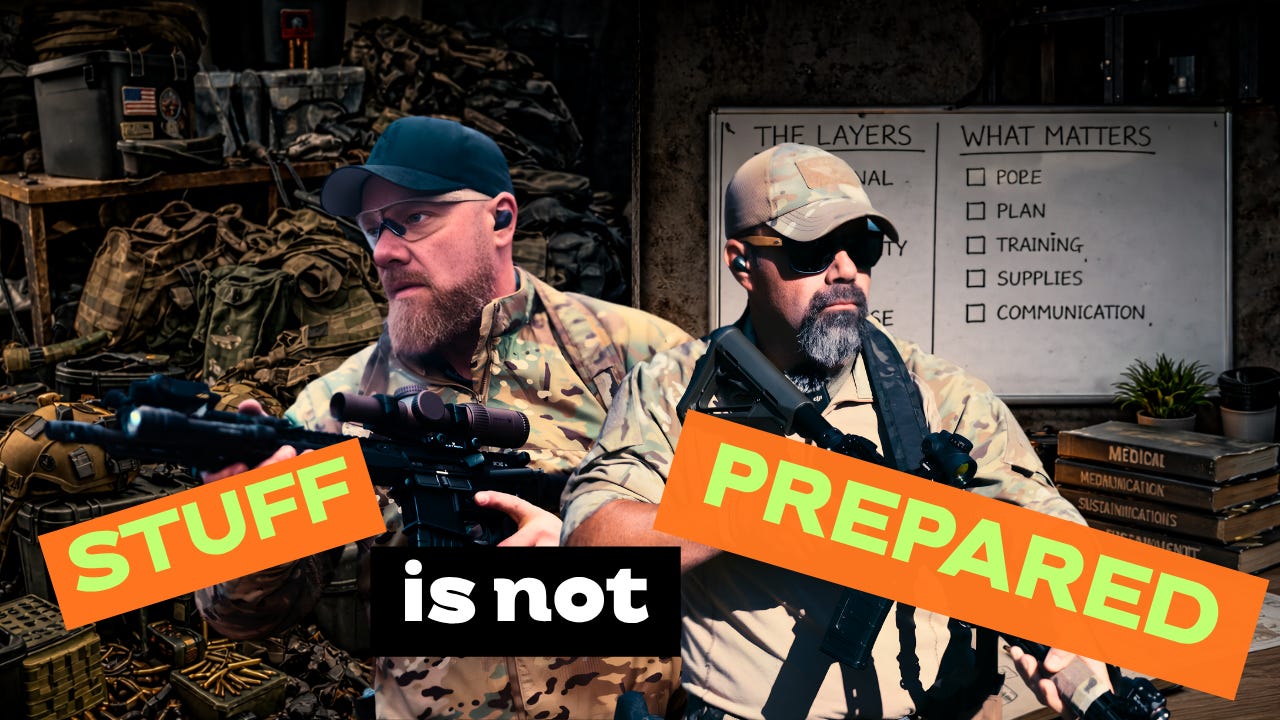
The Lie We’ve Been Sold
A lot of modern preparedness culture runs on fear.
That is not entirely irrational. The world is unstable. Markets shake. Wars threaten to widen. Supply chains look sturdy until they suddenly do not. Governments posture. Media amplifies. Screens glow. Everyone feels the pressure of uncertainty, and plenty of people know, at least instinctively, that something is wrong.
But here is the problem: fear is being used to turn men into consumers instead of builders.
The system feeds us uncertainty through screens, headlines, clips, and algorithmic panic. Then it hands us products. Buy this radio you have never tested. Buy this survival tool you have never used. Buy this bug-out bag even though you have never spent a cold night in the woods and do not know how half the contents work. Buy more gear, stack more bins, fill more carts, and call it readiness.
That is not readiness.
That is retail therapy with a camouflage pattern.
A man can watch videos about building a fire for ten hours and still fail to start one in the rain. He can watch radio tutorials and still have no idea how to communicate when it matters. He can own a full survival kit and be functionally useless the first time comfort disappears.
That is the trap. The world is trying to turn us into product consumers rather than skilled, resilient, capable men.
Preparedness is not what you own. It is what you can do when convenience dies.
That is the gap we are stepping into.
Start Here
Here is the move:
Stop letting fear drive your pocketbook.
Stop confusing consumption with competence.
Build readiness from the inside out.
Start with the man, then the family, then the community, then the region.
Focus on skills before accessories.
Keep faith in the foreground and panic in its proper place.
Use broad content for framework and paid content for implementation.
Build toward resilience, not just reaction.
We are calling this roadmap The Modern Day Minuteman.
Not as a costume.
Not as nostalgia.
As a framework.

The Real Problem
The real problem is not that people are blind to danger.
The real problem is that they respond to danger in the wrong order.
They build outward before they build inward. They gather equipment before they develop endurance. They buy tools before they practice skills. They consume more content without ever pressure-testing what they claim to believe.
That creates a dangerous illusion of competence.
A radio that has never been tested is not communication. A medical kit you have never trained with is not preparedness. A bug-out bag without field experience is not confidence. It is luggage for a fantasy.
And yet this kind of fear-driven content keeps winning because it scratches an emotional itch. It gives men the feeling that they are doing something when often they are simply purchasing symbols of action.
That is why so much preparedness content feels hollow. It trains men to collect. It does not train them to endure.
Fear sells fast. Skills build slow. That is exactly why skills matter more.
We have seen that deficiency clearly. Too many people are consuming survival content instead of developing survival ability. Too many are building identities instead of building systems. Too many are leaning on the market, the platform, the channel, the app, the expert, the personality, the next product drop.
But when real disruption hits, the market is not your muscle. The app is not your backbone. Digital convenience is not your resilience.
When things break, you fall back on what you can actually do.
That is why this has to be built differently.
Why the Order Matters
The Modern Day Minuteman framework starts with a hard truth.
If the man is weak, the structure will be weak.
That first layer is the individual. The self. The man.
If you are soft, passive, undisciplined, spiritually thin, physically weak, and mentally fragile, hard times will expose it quickly. Comfort is not evil, but comfort is an enemy when it becomes your master. A man who cannot function outside convenience is not prepared. He is domesticated.
So the first layer is about building the body, the spirit, and the habits that create resilience. Fitness. Skill. endurance. Spiritual strength. Practical competence. The ability to function when conditions stop being pleasant.
Then comes the second layer: family.
If your family is not prepared, then your family becomes vulnerable under pressure. That is harsh, but reality usually is. Emergency plans matter. Roles matter. Household systems matter. Communication matters. The family has to know what to do, where to go, how to think, and how to act if life suddenly gets harder than modern people are used to.
Then comes the third layer: community.
No one survives alone for long. Not well, anyway. You need people. Church matters here. Friends matter. Neighbors matter. Work relationships matter. Skills distributed through a trusted network matter. Not everyone is a doctor. Not everyone is a mechanic. Not everyone can cook, hunt, repair, or secure. But a functioning community knows where those capabilities live.
Then comes the fourth layer: region.
What kind of terrain do you live in? What climate pressures matter? What supply chain weaknesses affect your area? What does the political map of your region mean in a crisis? Who governs that space, and will civil authority help or hinder? What regional strengths can you lean on? What vulnerabilities are already present?
That is a serious undertaking, and it should be. It requires thought, humility, local knowledge, and honest assessment.
This is not random. It is a roadmap.
And it is built on biblical principles, practical survival skill, and the counsel of people who have actually lived this world, not just marketed to it.
What This Looks Like in Real Life
This ecosystem is going to be built in layers.
At the center is The Modern Day Minuteman. That is the flagship. That is the broad framework. That is where we lay out the foundational layers of preparedness and show how they connect.
Then come what we call “side quests.”
These are the narrower, more specific pieces. Product reviews in that you can actually trust. Skill based training with SMEs on things like Fire-building. Hunting. Specific survival skills. Practical capability modules. These are tighter, more targeted, and meant to help you add real tools and real competence to the bigger system.
Then there is the in-region community piece.
That means things like Friday Night Sights, training classes, community events, and real-world connection at Tombstone Gun Range and other areas in our region. Because this cannot live only on a screen. Preparedness that never leaves the content layer becomes entertainment. Brotherhood has to exist in real space, with real reps, real standards, and real people.
We will also produce macro-level videos that cover the pillars broadly and clearly.
Then for our supporters on Substack, we will go deeper. That is where the behind-the-scenes layer lives. More detail. More resources. More implementation tools. More practical frameworks you can use to build out your own system with intention.
This is not for us to get rich off of information, however this is a mission that is our full-time job and we can only continue with supporters who believe in our mission and purpose.
Because the goal is not to impress you with content volume.
The goal is to help you become resilient.
The mission is not to create better consumers. The mission is to create more capable men, stronger families, and tighter communities.
That is the point of the ecosystem.
Warning Signs
If you want to know whether your preparedness is drifting into fantasy, here are a few warning signs:
You buy more gear than you test
You watch more content than you practice
You can describe threats better than you can build systems
You own equipment you have never pressure-tested
Your family has no clear plan
You know online personalities better than local people
You react emotionally to headlines but never train steadily
That is not judgment for the sake of it. That is diagnosis.

Don’t Get This Wrong
There are a few mistakes that will wreck this fast:
Letting fear drive your decisions
Building outward before inward
Confusing possession with proficiency
Neglecting fitness and resilience while buying equipment
Ignoring family readiness because individual gear is more fun
Forgetting community because rugged individualism sounds cooler online
Treating faith like decoration instead of foundation
We are not building a panic cult.
We are not building a fantasy camp.
We are not building another content treadmill for anxious men with expensive taste.
We are building a framework for ordered resilience.
Read This Next
Proverbs, a chapter for each day of the month.
Nehemiah, the true story of warrior builders.
2 Timothy
Field notes from men who have actually lived and taught survival
Your own weak spots, honestly assessed for once, which is apparently a lost art
Question of the Day
Which layer is weakest in your life right now: self, family, community, or regional understanding?
Build With Us
So what are we building?
We are building a content ecosystem, yes.
But more than that, we are building a practical framework.
That means:
Modern Day Minuteman as the flagship spine
Side Quests that get narrower and more practical
Threat and intel content that stays useful instead of hysterical
Free Substack that organizes and deepens the framework
Paid Substack that turns the framework into tools, guides, and implementation resources
Classes, events, and community that move this from content into real life
This is a long-haul build.
Not a gimmick.
Not a one-month panic funnel.
Not a dopamine loop for men who want to feel serious without becoming reliable.
We are trying to create a body of work that helps people become more useful under pressure, more grounded in truth, and more capable of leading where they actually live.
The goal is to begin rolling this out in early May, and if that mission resonates with you, support the paid side and get in at the ground floor as the ecosystem starts to take shape.
Final Word
The future may get harder. That is possible. Maybe likely.
But fear does not have to be your master.
We are going to build with faith in front, skills in hand, and community in view. We are going to build from the inside out. And we are going to help other people do the same.
And remember in the end, God Wins.
Wow, this one kinda hurt. Thank you. I needed that.
Very good article! I firmly believe that it's hard to teach people things after a certain age. I grew up in a semi-rural environment with pets and livestock, and a garden and fruit trees. I always joke that my husband grew up in a concrete jungle, living in an apartment. Some things you just learn from the area you grew up in. Thankfully, my sons are more like me, they know how to butcher a chicken, shoot guns, and build a fire. Letting boys be boys is a great place to start.